
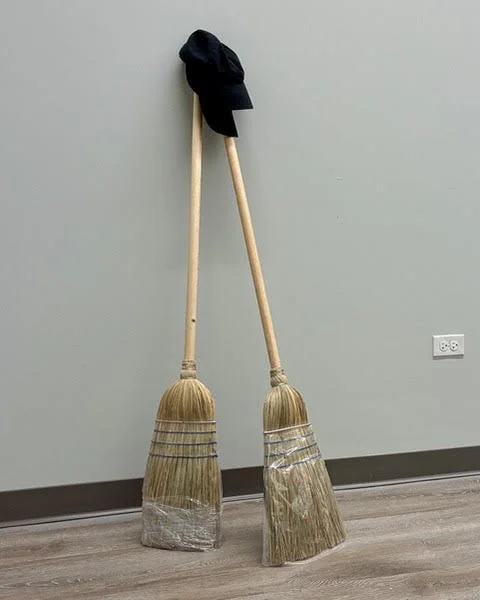
ROBERT FIELDS, “If I am only for myself, what am I?” 2026.
Baseball caps, a pair, and brooms (2).
58 X 24 x 18 inches
September 13 - October 17
“EVERY NOW N’THEN . . . ”
Robert Fields
Opening Reception: 2 PM to 6 PM, Sunday September 13, 2026
BOB FIELDS is an interdisciplinary artist . . . including sculpture, printmaking and mail art. He holds an MFA from the Pacific Northwest College of Art, Portland, OR, and a BFA from the School of the Art Institute of Chicago.
Fields often creates three dimensional Works responding to our tumultuous, polarized time . . . occasionally peppered with a pinch of his personal story.
He believes Art can surprise us, by capturing our attention, stir curiosity, and wonder. By encouraging creative, honest conversation, trust, Art demonstrates how looking through alternative lenses . . . close reading, teasing-out previously unimagined approaches . . . New Solutions can / and do unexpectedly appear . . . Encouraging the taking on of more courageous approaches in solving /establishing a more equitable + peaceful world.
For Fields, making begins with Observation. / Questions. / Followed by yet more Questions. Leading to Research. / More Reading. / List making. / Sorting. / Sketching . . . while adding-in a pound or two of Risk-Taking for good measure. Materials / processes and scale are also considered as to how they contribute to context, expand upon the narrative, capture and hold the viewers’ curiosity. All the while looking / listening to the work: “Say what?” //
~BF / 8.31.2026
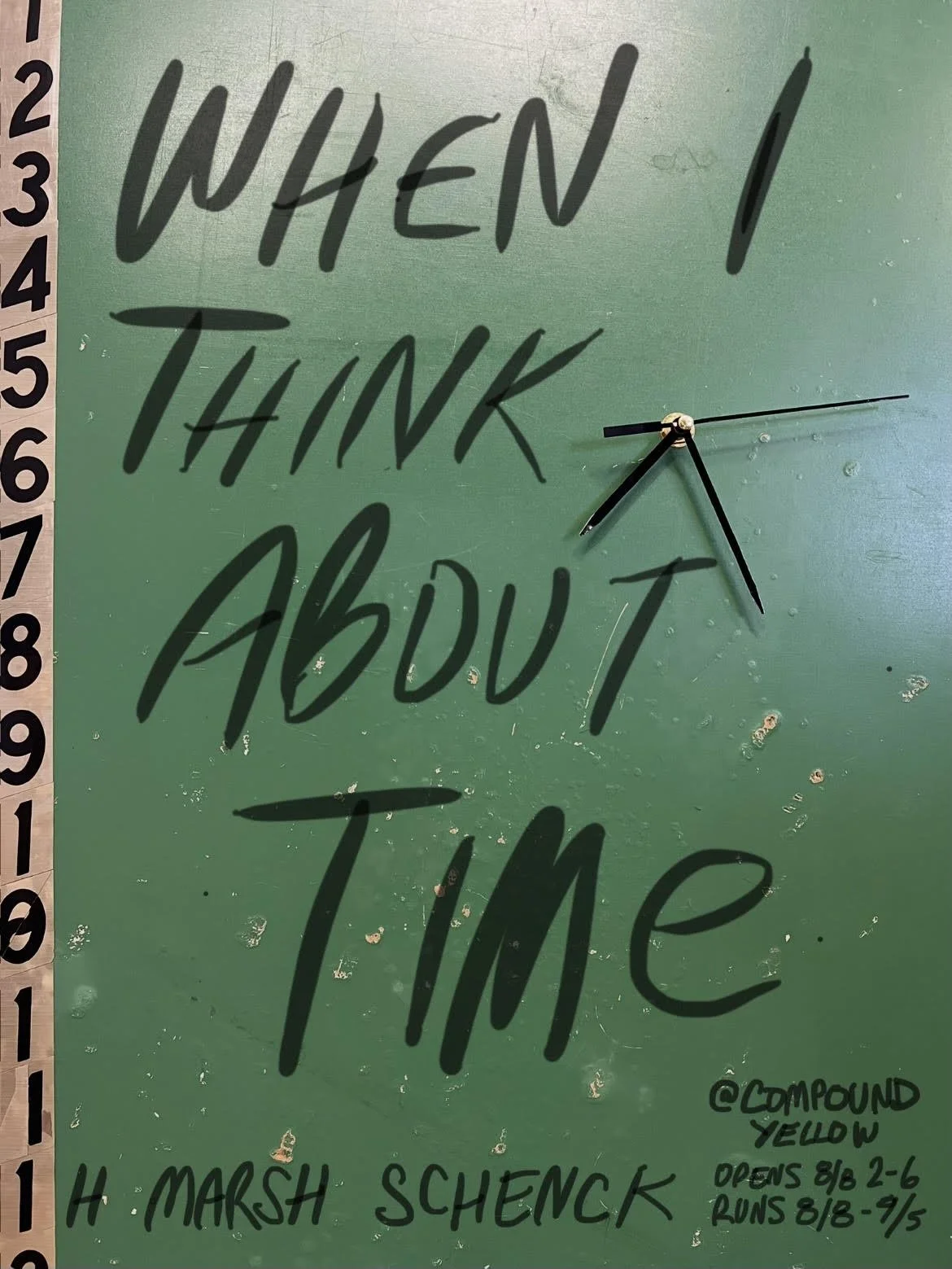
AUGUST 8 - SEPTEMBER 5
when i think about time
H Marsh Schenck
Opening 8/8/26 2:00 - 6:00 pm.
when i think about time is a site-specific installation examining how time is experienced, measured, distributed, and utilized within (U.S.) American culture. Rooted in my experience as a trans person living with Functional Neurological Disorder (FND), this exhibition challenges the idea of time as a universal construct and reveals access to time as inequitable.
My relationship to time fundamentally changed after learning how to navigate: chronic fatigue alongside forty-hour work weeks, prolonged waiting periods for specialists in between other, weekly medical appointments, and the general daily labor of eating, sleeping, and cleaning the house. Time became something to budget rather than live in. Something scheduled months in advance. Something shaped as much by economic circumstance, disability, and bureaucracy as by clocks or calendars. when i think about time asks: Who has access to time? How is time measured? Who determines its value? How much of our lives are lost to systems that demand productivity while delaying care? And what becomes possible when we begin to reclaim our time?
The objects in this exhibition reflect these ideas through materiality. Building on the installation from my past exhibition, Both/And: a queer archive of belonging (Boundary, Chicago, 2025), this new body of work similarly uses objects as reservoirs for history, while also pointing viewers to assess their understanding of time. Mirrors, clocks, mobility aids, annually pruned Christmas trees, and sculptures assembled from inherited, found, and repurposed materials become records of lived experience, examining how memory, disability, labor, tradition, and identity construct our understanding of time.
Within the exhibition, clocks reflected in mirrors suggest that time is always contextual: perspective determines interpretation as much as measurement. A collection of walking canes on an aromatic cedar rack nods to histories, adaptations, and care. An ascending series of pruned Christmas trees marks an annual tradition, transforming holiday waste into a visual record of grief, healing, renewal. Every object carries multiple histories, resisting singular definitions of purpose, authorship, permanence, and time itself.
Rather than presenting time as linear, when i think about time embraces cycles, transition, and continual reinvention. Memories become artifacts. Artifacts become collaborators in remembering. Traditions preserve histories while creating opportunities for change. Sculptures function as unburied time capsules, preserving histories, accumulating time, and changing with age.
Once we unpack and identify that the social normative construct of time is not a universal concept, we must ask ourselves: Who determines ‘normative’ standards of time, and who continues to maintain systems that influence how we access time? Whose interpretation and application of time is disciplined, medicalized, or exploited? Who has time off? Who has to wait for healthcare? Who has to sacrifice time simply to survive? Who benefits from these structures?
These questions extend beyond disability. They ask us to reconsider how time is allocated across systems of labor, healthcare, education, class, race, and identity. Ultimately, when i think about time invites viewers to reconsider not only their perception of time, but its function, authorship, and application. This exhibition imagines a collectively authored time, one founded in community and generosity rather than extracted through labor; defined by shared meals, holiday rituals, art exhibitions, conversation, collaboration, and trust.
when i think about time is an invitation to imagine: If we remove productivity as the primary qualitative measure of a human life, what new systems could we imagine? What could we accomplish if we internalized rest and care not as irresponsible distractions from productivity, but as essential tenets of meaningful lives?
How do we slow down time? And, most importantly, how do we create time for one another?
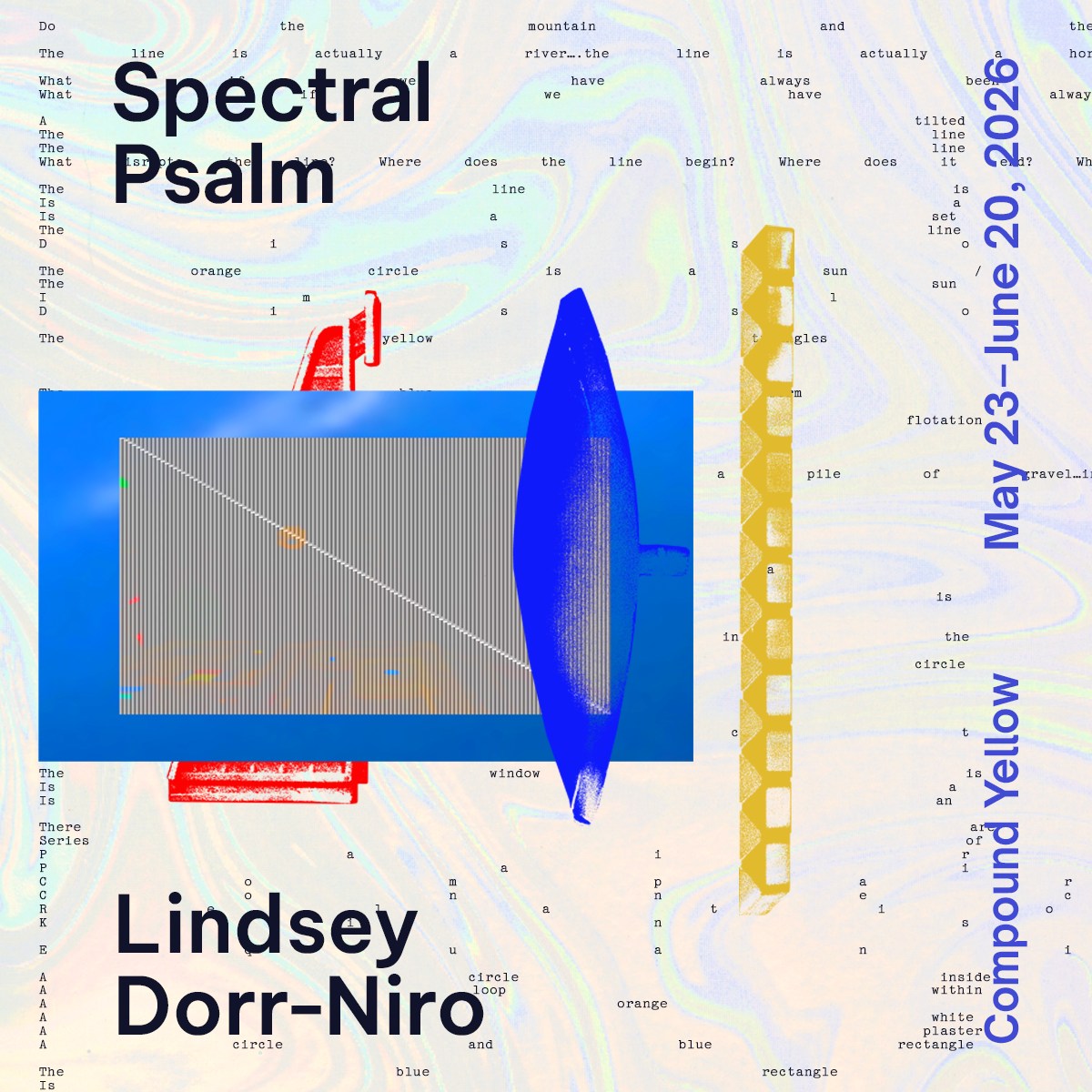
MAY 23 - JUNE 20
Spectral Psalm A Solo Exhibition by Lindsey Dorr-Niro
Psalm.
Song.
What is a Spectral Psalm?
One definition of psalm is a sacred poem or song accompanied by music.
We find ourselves in a moment where it seems nothing is deemed sacred -- a crisis of the sacred we might say. So much of the violence and suffering we are witnessing is the result of an extractive materialist worldview that sees only convenient objects and resources. And yet, if we take sacred to denote “worthy of profound reverence or awe,” we are reminded just how much of what makes this life worthwhile is precisely sacred.
What might a practice of sacred vision--sacred looking look like? Could we practice seeing the world this way, through the eyes of wonder, openness, and possibility rather than objectification, separation, and circumscription?
Can we live in the moment—the space before the name?
A common device used in psalms is parallelism, a structural technique where thoughts or ideas rhyme. The second line repeats or reinforces the thought of the first line using similar words.
Spectral Psalm is a song of pairs, pairing, parallelism. Of recursion, Of connection, Of interdependence.
A Spectral Psalm blinks in and it out. It weaves back and forth from the mediated to the direct, the rational to the more mysterious and absurd. It holds this space. It lives in between. It sings through it.
Lindsey Dorr-Niro (BFA University of Wisconsin-Madison, and MFA Yale School of Art) is an artist and educator based in Chicago. Working primarily through large-scale installations, her practice constructs contemplative environments that invite relational and elemental awareness. Her workemphasizes the space between forms—foregrounding interdependence, emergence, and transformation—and encourages viewers to engage in processes of reimagining both world and self. Dorr-Niro’s recent exhibitions include In/Situ for: bye, bye Avondale (Chicago, 2025). She has also exhibited at Wedge Projects (Chicago), Ditch Projects (Springfield, OR), and Regards (Chicago).
In the studio with Sonnenzimmer as shared in Sonnengram newsletter.
[*All images in collaboration with Sonnenzimmer (2026)]
APRIL 11 - MAY 9
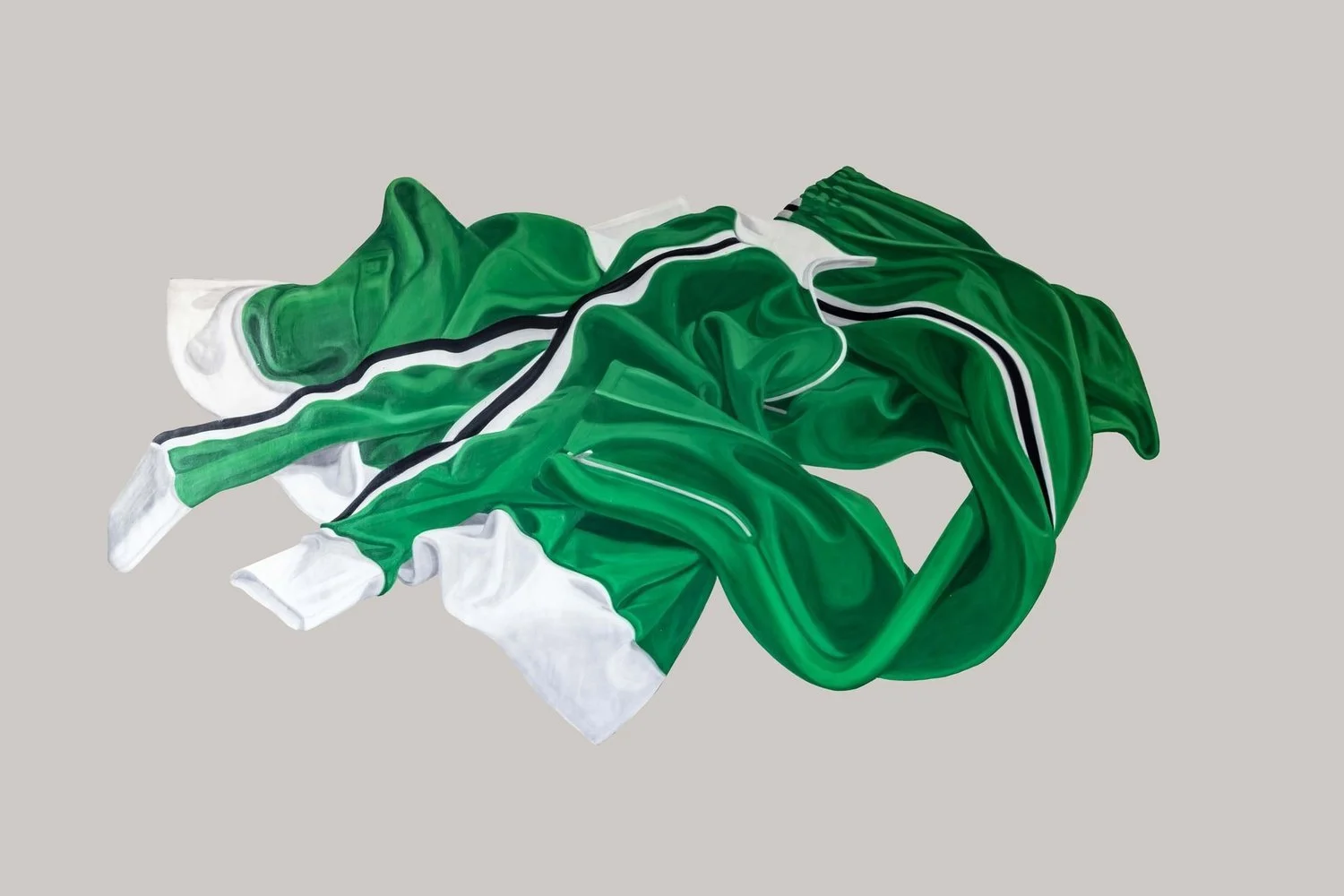
REAL ILLUSIONS Works by Lois Baron
LOIS BARON: REAL ILLUSIONS
At age 90, artist Lois Baron revisits the work that first brought her recognition in New York City during the early years of her career. Real Illusions presents Baron’s cut-out paintings of clothing—highly illusionistic images mounted flush to the wall so that they appear painted directly onto its surface. These large-scale works hover between flatness and dimensionality, shifting visually between image and object.
Baron began receiving critical attention with her first group exhibition in 1974, reviewed by John Perreault in The Village Voice. Her work was subsequently reviewed by notable critics including Peter Frank and Gerrit Henry (Art News), Lawrence Alloway (The Nation), and Carla Sanders and Ellen Lubell (WOMANART).
In 1982, Baron moved to Bangkok, Thailand when her husband accepted a professional position there. That same year she presented a solo exhibition at the Bhirasri Institute of Modern Art titled Postcards from Africa, based on a six-week trip through five African countries connected to her husband’s work.
While living in Bangkok, Baron continued exhibiting and received coverage in both Thai and English-language newspapers. She also curated exhibitions of Thai artists at the Rotunda Gallery of the English-language library.
Returning to New York alone in 1985 following her separation, Baron found herself responsible for fully supporting herself and was unable to maintain a studio practice for nearly three decades due to limited time and space. During this period she worked in nonprofit development and earned a Master’s degree in Nonprofit Management from The New School.
After relocating to her birthplace of Chicago in 2010, a change in circumstances allowed Baron to return to painting. Her more recent work includes still lifes and portraiture, including her exhibition Time and Identity at the Swedish American Museum in 2021.
Baron studied at the New York Studio School of Drawing, Painting and Sculpture from 1966 to 1969, primarily with Alex Katz. Other instructors included Milton Resnick, Philip Guston, Leland Bell, and Louis Finkelstein.
APRIL 11 - MAY 9
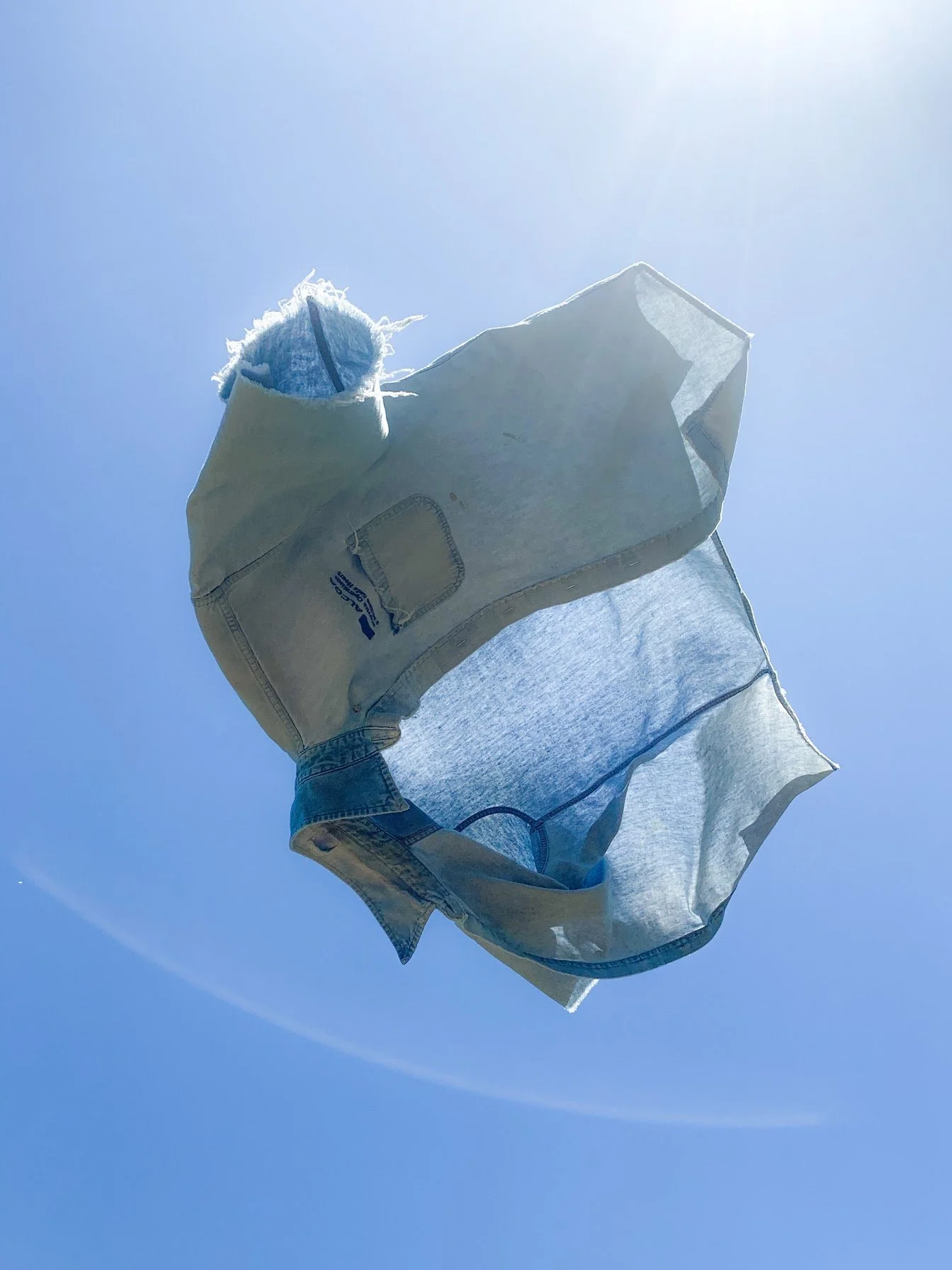
The Blue: Works by Isaac Couch
Isaac Couch
Originally from Western Kentucky, I have carried the textures, tensions, and rhythms of the South to Chicago. My work, that is rooted in fashion, but never confined by it, has earned fellowships with Luminarts (2021), the Arts Club of Chicago (2023-24), Chicago Artist Coalition (2024-26), and has been shown in spaces from the Comfort Station, Co-Prosperity Sphere, Epiphany Center of the Arts, to EXPO Chicago. Between the studio and the classrooms of SAIC, I work to challenge the fashion standards, explore the truth in my identity, and inspire students to do the same.
MARCH 7 - APRIL 4
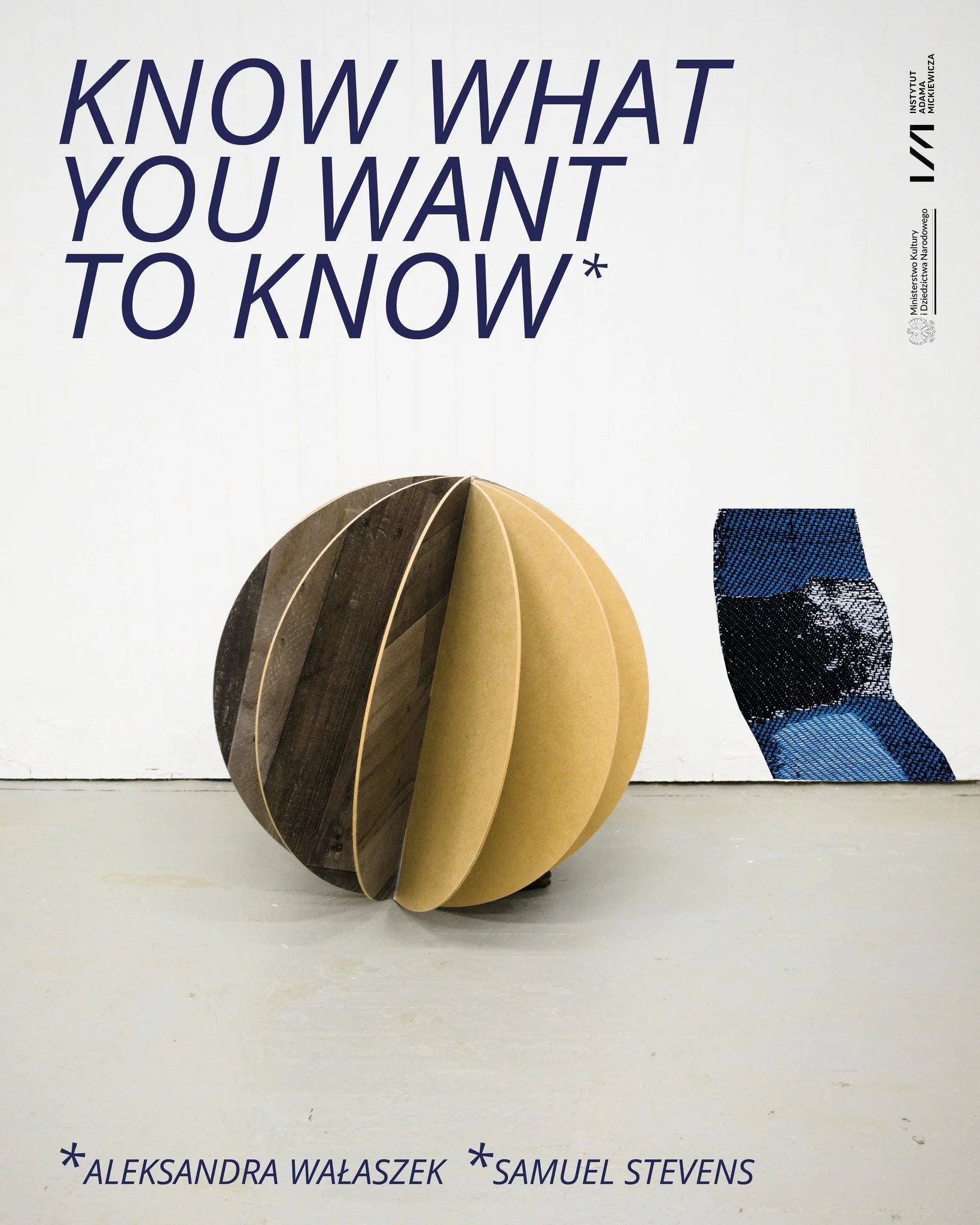
Know what you want to know * Aleksandra Wałaszek & Samuel Stevens.
New works trace how accidents and external forces become part of personal realities. Landscapes and bodies mutate into algorithmic instructions – mediated or lived, aligned to shifting social logics, with reality scaled to fit. The artists ask through collage and video, weaving and carving: What is a promise never kept, an armistice of gazes, an ignored apology? The exhibition is informed by times of unrest, and unseen forces; they consider that an invitation to exit requires rehearsing the welcome again.
Aleksandra Wałaszek received an MFA in Fiber and Material Studies from the School of the Art Institute of Chicago (2024) and an MA in Media Arts from the Eugeniusz Geppert Academy of Art and Design in Wrocław (2011). She is a recent recipient of the Fulbright Graduate Student Award, and ReSide Award. Her works have been exhibited nationally and internationally at various venues, and has participated in artist residencies. Her practice examines the coexistence of beauty and crudeness, hospitality and hostility, references architecture, and sources archives.
Samuel Stevens holds an MFA in Sculpture from the Eugeniusz Geppert Academy of Fine Art and Design, Wrocław (2020) and a BFA in Painting from the Kansas City Art Institute (2016). He is the co-founder, with Wałaszek, of Forma Otwarta, an artist-run space in Oleśnica, Poland, where he curates exhibitions and collaborative projects. His practice embraces site-specificity and experimental making, weaving together elements of craft, architecture, and ephemeral encounters to reimagine our relationship to space and objects.
Co-financed by the Minister of Culture and National Heritage of the Republic of Poland.
*This project was realized within the frame of the Adam Mickiewicz Institute’s ReSide program.
JANUARY 31 - FEBRUARY 28
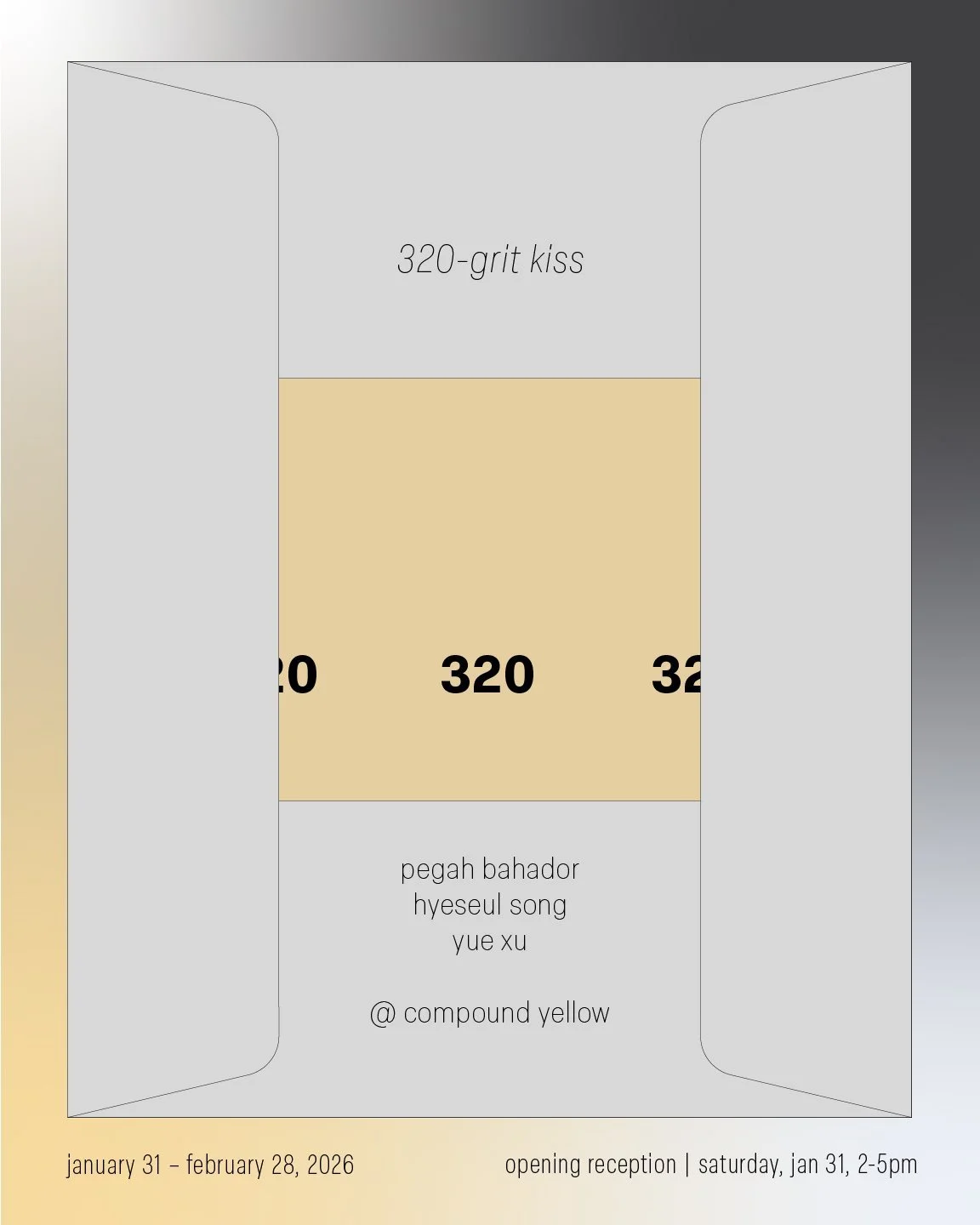
320-grit Kiss: New works by Pegah Bahador, Hyeseul Song, and Yue Xu.
In 320-grit Kiss Pegah Bahador, Hyeseul Song, and Yue Xu, have organized the space to reflect on desire, tactility and surface. Including drawings, photographs, sculptures and installations, they explore desire as an immanent assemblage that slides along skins, images, screens and inscriptions. Many of the pieces are gathered as temporal arrangements that are packable or emphasize mobility through sites, and therefore study surface as time.
The title borrows from sandpaper: 320 grit, a medium grit, neither coarse nor smooth, to prepare, to soften and make a surface ready. Skin, too, is a surface that rubs, presses, and carries memory. Weightless, mobile and tactile, suspended and remembered, it lives on the surface and is of the surface. It is closeness without access.
Pegah Bahador (b. 1998, Tehran) practices doori o doosti, a Farsi term that translates to ‘distance and friendship,’ and emphasizes how the two coexist and (even sonically) intertwine. This epistolary practice suggests writing as an act in translation, or with an accent; and is itself a type of correspondence between them and their subjects. They work between sculpture, drawing and text to emphasize ground and language displacement. They earned their BFA at Tehran University of Art and are currently pursuing their MFA in Art, Theory, Practice at Northwestern University.
Hyeseul Song (b. 1995, Seoul) is a visual artist whose practice centers the overlooked objects and the material traces embedded within built environments, working across sculpture, photography, and digital media. Trained in both architecture and sculpture, she approaches the built world as an archaeological site—one where layers accumulate, disappear, and transform through the shifting pressures of development, utility, and time. Song holds a Bachelor of Architecture from Sungkyunkwan University (2021) and a BFA in Sculpture from the School of the Art Institute of Chicago (2023), and she is currently pursuing an MFA at the University of Chicago.
Yue Xu (b. 1995, Guangzhou) is an artist based in Chicago. Xu is a multimedia artist working with sculpture, installation, drawing, and artists’ books to point toward forces—often invisible or taken for granted—that structure everyday life. Her practice engages with the latent poetics of overlooked landscapes, where mundane encounters rupture unexpectedly, revealing moments of estrangement. These disruptions awaken dormant visual memories, destabilizing familiarity and summoning fleeting remnants of the past. Xu earned her MFA from the School of the Art Institute of Chicago in 2021 and her BFA from Guangzhou Academy of Fine Arts in 2018.