
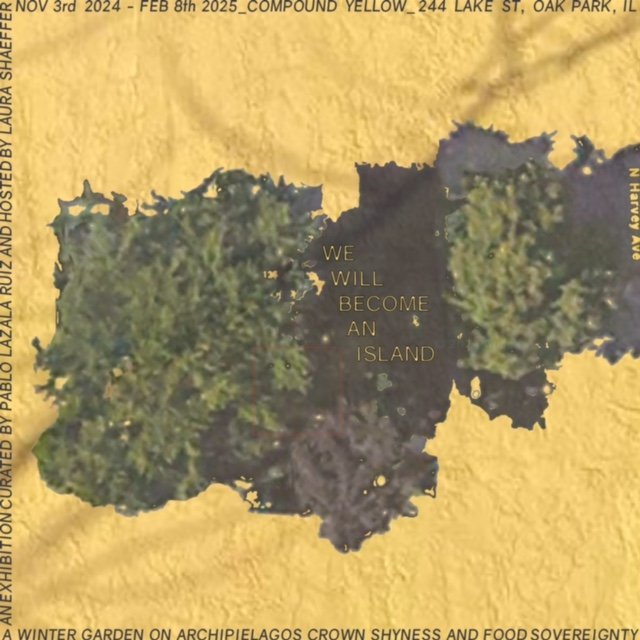
November 3 - January 25
We Will Become An Island: An Exhibition Curated By Pablo Lazala Ruiz
Opening Sunday, November 3, 2024
4:00 PM 8:00 PM
We will inhabit, maintain, and wander a winter garden for the next three months.
Archipiélagos are island ecosystems of closeness and proximity. Likewise, a mature tree canopy, full of almost touching tree crowns (timidez bótanica, crown shyness), teaches us (shows/allows/whispers) how bodies that breathe next to each other cooperate and acknowledge other bodies.
How to be bodies that are part of different bodies.
How to be bodies floating on water and living in the sky.
How the many bodies that form us and we form part of our bodies that we know with our entirety.
The practices of this group of artists—their actions, objects, and voices—are planted, nourished, and trimmed, together, in this space. They allow themselves (their many selves) to move, rearrange, and reedit their territories of occupation, to become islands; an archipiélago of crown shyness—imperfect crowns.
These artists acknowledge that when someone refers to a living and breathing world as "a floating island of garbage," many others will continue organizing, weaving, and resisting around them. In becoming islands, the many islands, they cannot be disposed.
ALBERTO AGUILAR, SAOIRSE C. AHUMADA FURIN, ELENA AILES, PEDRO ALBERTINI, CAMILA AREVALO, MARLENA MARG BRACKEN, GABRIELA ESTRADA LOOCHKARTT, LUCAS FAHEY, JUAN DAVID FIGUEROA, NICOLA FLORIMBI, SOFIA FERNANDEZ Y SOFIA GABRIEL, MARCO GUAGNELLI, JAIMIE LEE, SUN LYNN HUNTER, PEDRO MONTILLA, MERRYN OMOTAYO ALAKA, AVA ORRANTIA, KATA ORTIZ-THORNTON, JEFFERSON PINDER, FERNANDO SALDIVIA, DAVID SPECHER, ALLONDRA SULLANI SORIA, SUNI SONQO VIZCARRA WOOD, CHRISTIAN VARELA, BERENICE VARGAS BRAVO, JAVIER VINUELA, ALEKSANDRA WALASZEK, HUNTER WHITAKER-MORROW, ADRIAN WONG, SIOBHAN AJR WOOD, KELLY XI
AUGUST 24 - SEPTEMBER 29
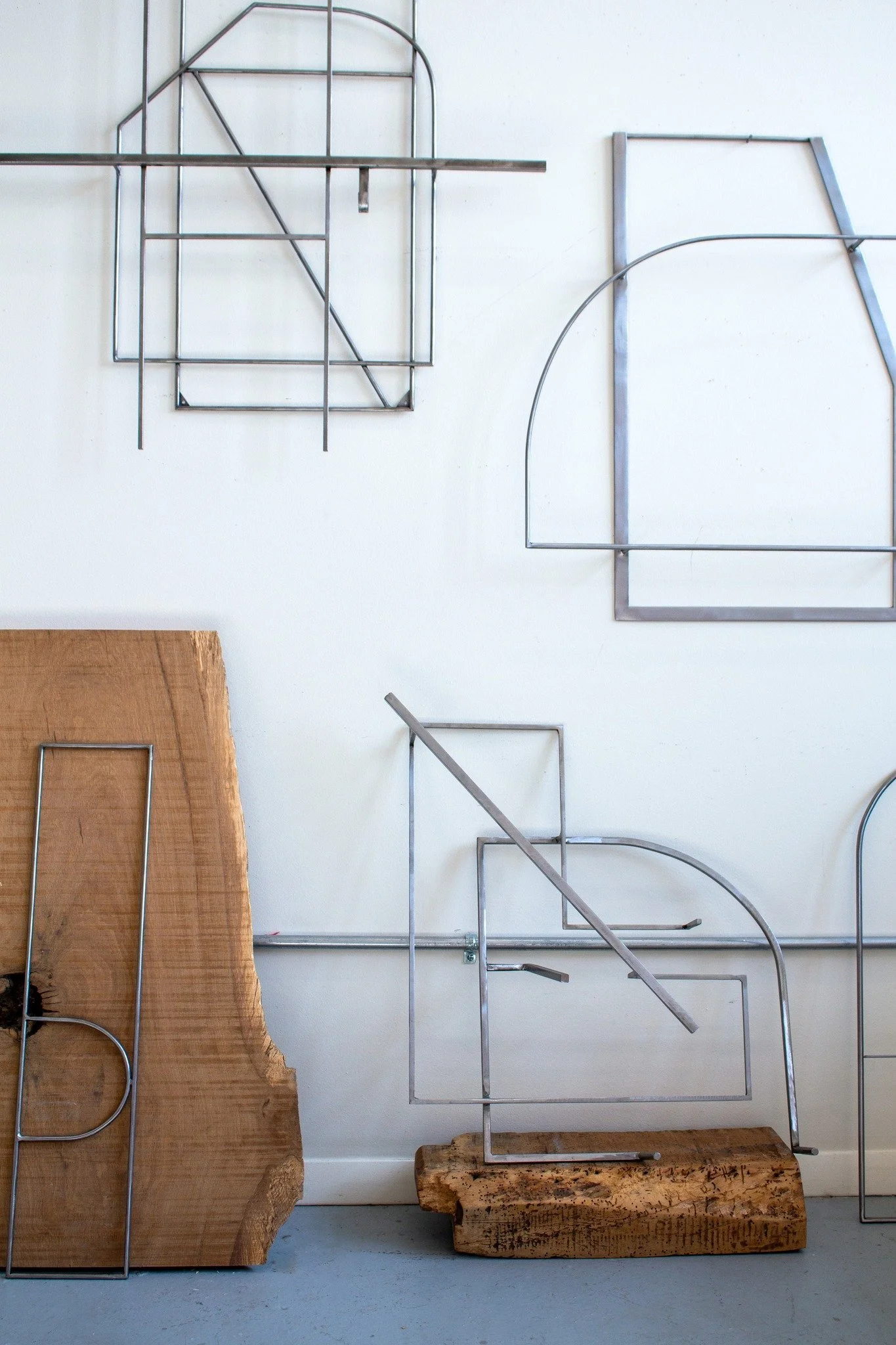
Same Difference: Solo Exhibition of New Works by Allison Wade
Relentlessly mining the familiar for the novel and the novel for the familiar. With this series of metal, ceramic and fabric work, I found freedom by setting compositional parameters, creating frames for myself. Simple components coalesced into more complex arrangements, with adjacencies highlighting similarities and differences. No matter which means I employed, the end came back to the pleasure of seeking new ways to fit and manipulate material into my own established (but expanding) lexicon.
Allison Wade is a visual artist and educator working primarily in sculpture. Her practice is material-based, intuitive, and formally focused. She combines ceramics, textiles, wood, and metal into unexpected, often tenuous arrangements that explore the intersection of flatness and form. Wade’s process, which she likens to syntax, is closely aligned with writing. Deploying an idiosyncratic visual language, she explores the structural and formal contingencies of her materials and sculptures, grouping them into words, sentences, and paragraphs that function both as distinct elements and parts of a whole.
***
Save the dates: Allison Wade will be present at the gallery Saturday, September 14 and on the final day, September 29 (both from 2-5pm).
JULY 12 - AUGUST 17
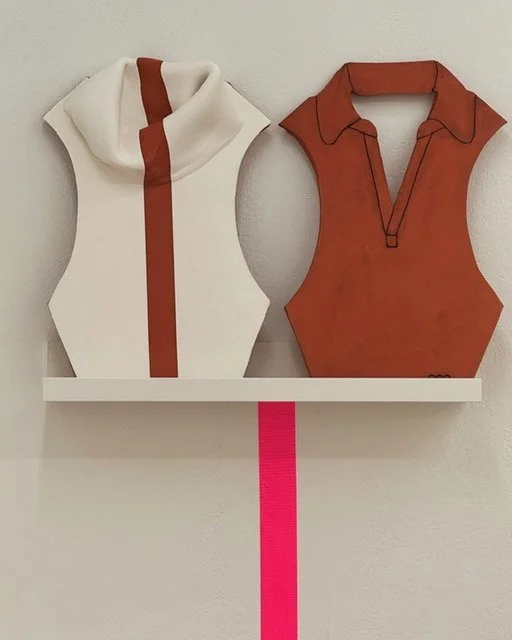
Matching The Drapes: Solo exhibition and fashion show by Elizabeth Burke-Dain
Opening: July 12, 2024, 6:00 - 9:00pm
Taken from the irreverent adage “does the carpet match the drapes?,” this exhibition playfully explores bespoke garments made from repurposed curtains, bed linens, and other household fabrics imbued with memories of comfort and family life, but it is also about how clothes fit. Clothes found in shops are versions of the ideal and as consumers we are constantly disappointed and sometimes ashamed that the ideal is not in our purview. The ceramic collar models in the gallery are meant to represent the perfect, but you can’t wear them. The fantasy that fashion elicits will always allude you.
The show at Compound Yellow, an alternative art and performance space in Oak Park, combines Burke- Dain’s new ceramic work with self-taught clothing construction. Together with clothing design,the presentation features a series of ceramic collar forms reminiscent of display mannequin busts found in department stores .
After a long hiatus from sewing quilts and other basic structures, Elizabeth Burke-Dain started to sew again during the Covid lockdown along with thousands of others who took to making masks for under-equipped front line healthcare workers. Because most shops were closed, she made masks out of any fabric in her “sewing larder”-- cast-offs from forgotten sewing projects, old duvet covers, discarded curtains, and remnants collected from garage and estate sales. Working with fabrics again and making patterns reconnected her with sewing.
In the first months of the pandemic, webinars and online workshops became a place of distance gathering, working, and learning in the new normal of lockdown When Laura Shaeffer, Director of Compound Yellow, invited the artist to a twelve- week webinar held by a group of designers and fashion historians to make a workers uniform, she was all in. The group modeled themselves after the Victorian dress reform organization the Rational Dress Society.
The Rational Dress Society’s ethos, written in 1881 in London, was to create the “perfect dress” as a reaction to the restrictive corsets, crinolines, and heavily weighted skirts that impede the movement of the body. Even Oscar Wilde, whose wife Charlotte was an RDS follower and activist, wrote enthusiastically in his publication “The Philosophy of Dress” in which he stressed the important relationship between clothing and one’s soul.
“It requires all to be dressed healthily, comfortably, and beautifully,” — wrote Florence Wallace Pomeroy, one of RDS’s founders and member of the Lady Cyclists Association, “to seek what conduces to birth, comfort, and beauty in our dress as a duty to ourselves and each other.”
A uniform was the chosen garment to teach in this webinar due to its being a ubiquitous garment that is mostly created from the labor of low wage workers for low wage workers. Generally, it comes in three restrictive sizes based on the bodies of males in the military. S, M, L. This group of radical designers crowd-sourced the measurements of hundreds of bodies and came up with over 170 sizes, each of which was cataloged under a variety of titles: Alpha, Spring, Cairo, etc..
During the learning process, Burke-Dain began to understand how difficult it is to “fit” a piece of clothing to the body. Despite its utility, a one-piece uniform is not an easy garment to make or measure, and it is especially difficult for a woman’s body. It has all the basics: darts, gussets, a notched collar, zipper, arm holes, cuffs, pockets, raglan sleeves, and myriad other tiny details that must painstakingly be learned and perfectly measured before moving from one step to the other.
Six months and ten uniforms later, she still struggled with hips being too tight or the crotch being weirdly shaped. The finished items, despite the efforts to have patterns in a broad diversity of sizes, didn’t fit right. Something was off in the arm holes, the waist, or the shoulders despite the careful measuring of all the critical areas. She concluded that sewing for other people’s bodies is not for the light-hearted. Making things fit is a sublime skill that she wanted to learn more about. The Rational Dress Society was right, she concluded, comfort is beauty and we should be dutifully comfortable for ourselves and others.
After working on the complexities of the jumpsuit design, she was ready to make a wrap skirt — one of the easiest garments to make and fit onto the body. She then moved on to more difficult designs and learned many of the basic mysteries of clothing construction.
“Never in my life did I think I would be able to do this,” says Burke-Dain. “This exhibition is my journey into and a celebration of personal style. I wanted to approach this project and exhibition as if I was a working designer creating a signature collection that culminates in a runway show.”
The Compound Yellow gallery is Burke-Dain’s tricked-out dream boutique. The ceramic collars are the shop’s decor. “Matching the Drapes” is a bit of personal theater and fantasy for the artist. The show closes on August 17, and interested fashionistas can contact her for a fitting of one (or many) of the garments displayed in this summer exhibition. They can bring in fabric pieces from their own “sewing larders” or, if they wish, a purchased fabric from a shop.
SHOW DETAILS:
DATE: FRIDAY, JULY 12, 6 pm - 9 pm
COMPOUND YELLOW, 244 Lake Street, Oak Park (one block from Green line Ridgeland stop)
FASHION SHOW: 7 pm
Models: Lindsey Rauba, Ola Gorczynski, Laura Shaeffer, and Tracy Burke-Beckers
MUSICAL PERFORMANCE BY COWBOY JANE: 8 pm
CLOSING: August 17
MEDIA INQUIRIES: Elizabeth Burke-Dain, eburkedain@gmail.com, 773.368.4928
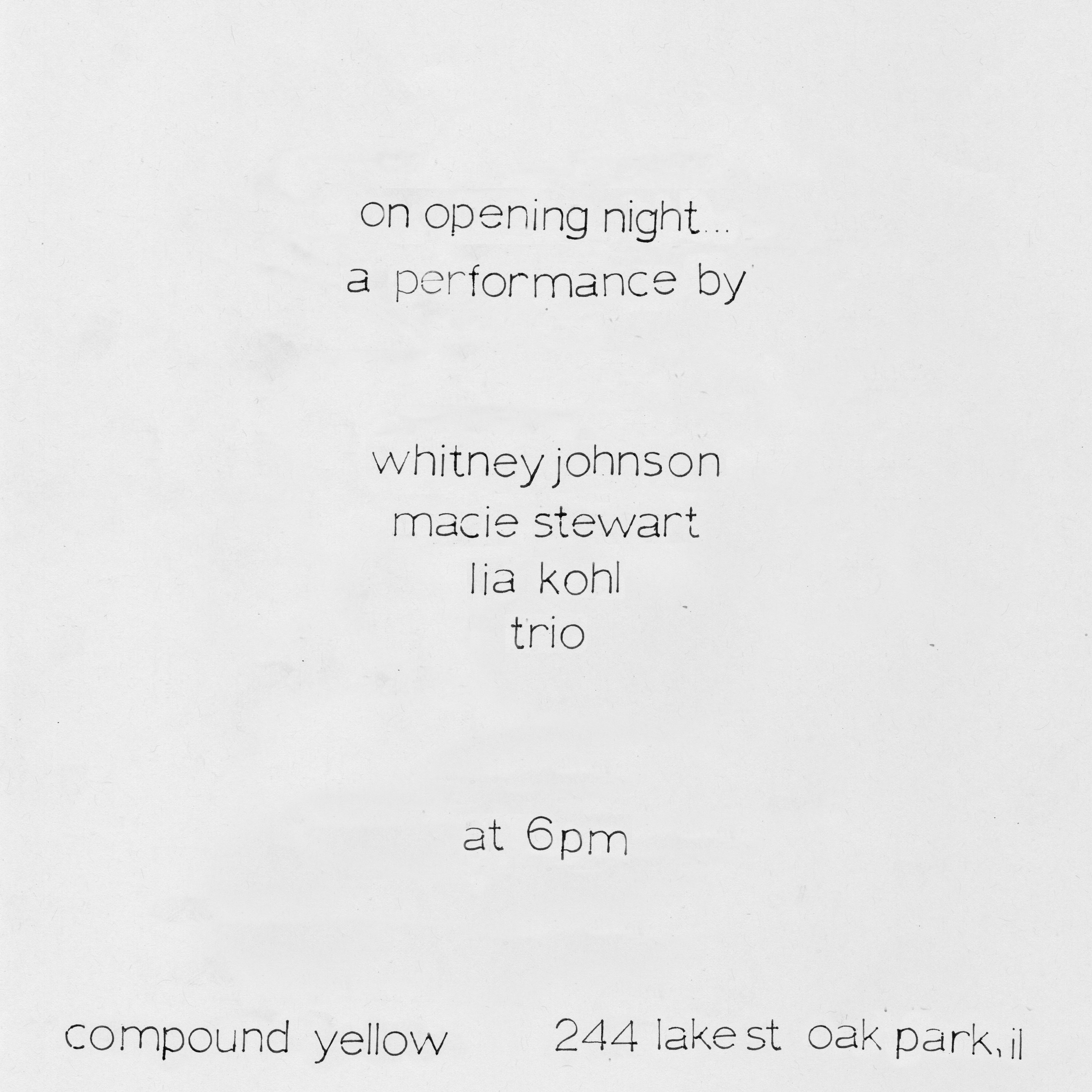
MAY 11 - june 8
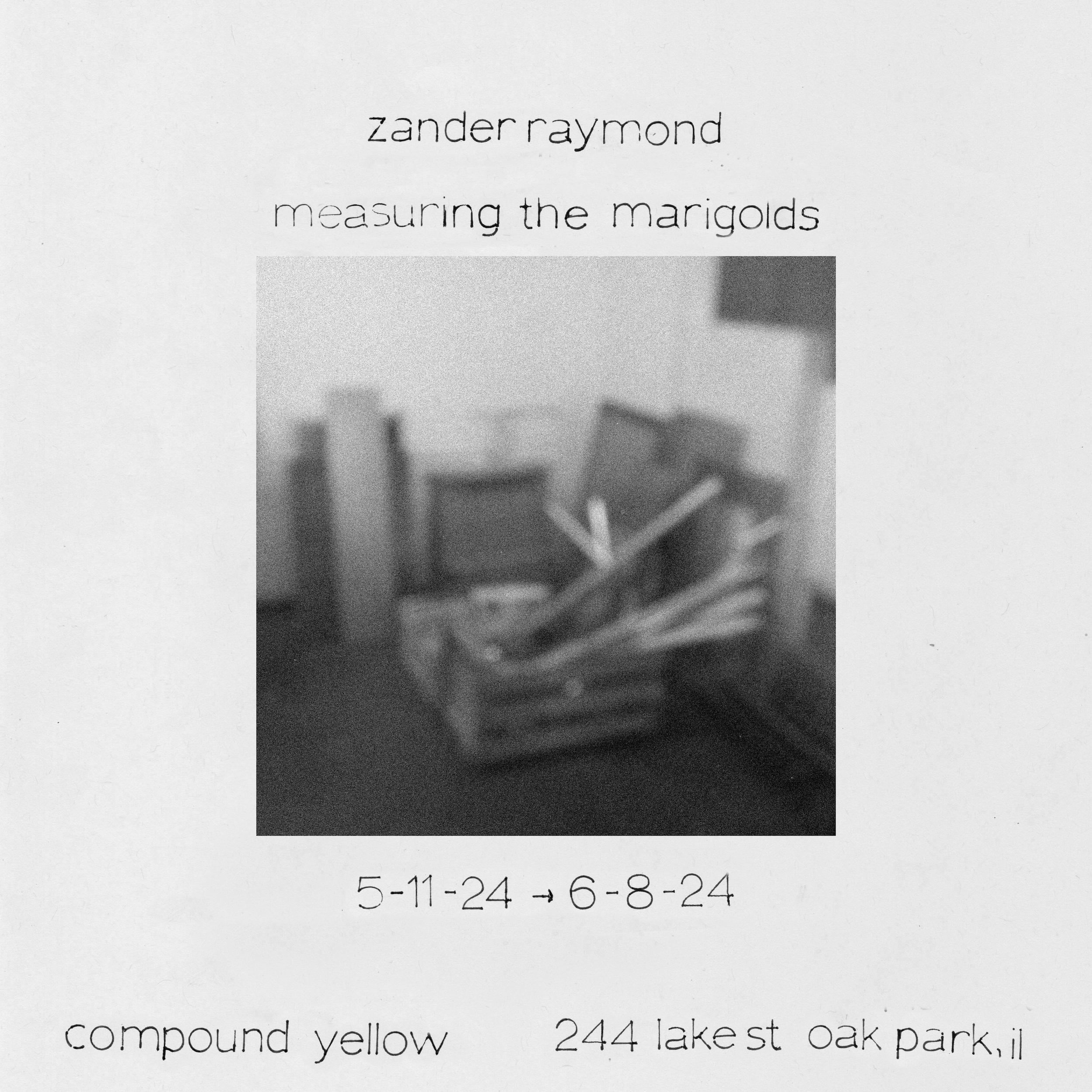
“Measuring the Marigolds” OPENING - Zander Raymond
Opening: May 11, 2024, 6:00 - 9:00pm
Open Every Saturday from May 11th, 2pm to 6pm
Opening of Zander Raymond’s solo exhibition “Measuring the Marigolds” on May 11th from 6-8pm. Performance at 8pm
Zander Raymond is an interdisciplinary artist and musician working in Chicago. His past projects have been hosted by Devening Projects (Chicago, IL), Switch hook Projects (Chicago, IL), Weatherproof (Chicago, IL), Mayfield (Forest Park, IL), Agatha’s (Buffalo, NY), among others. He holds a BFA in studio from The School of the Art Institute of Chicago.”
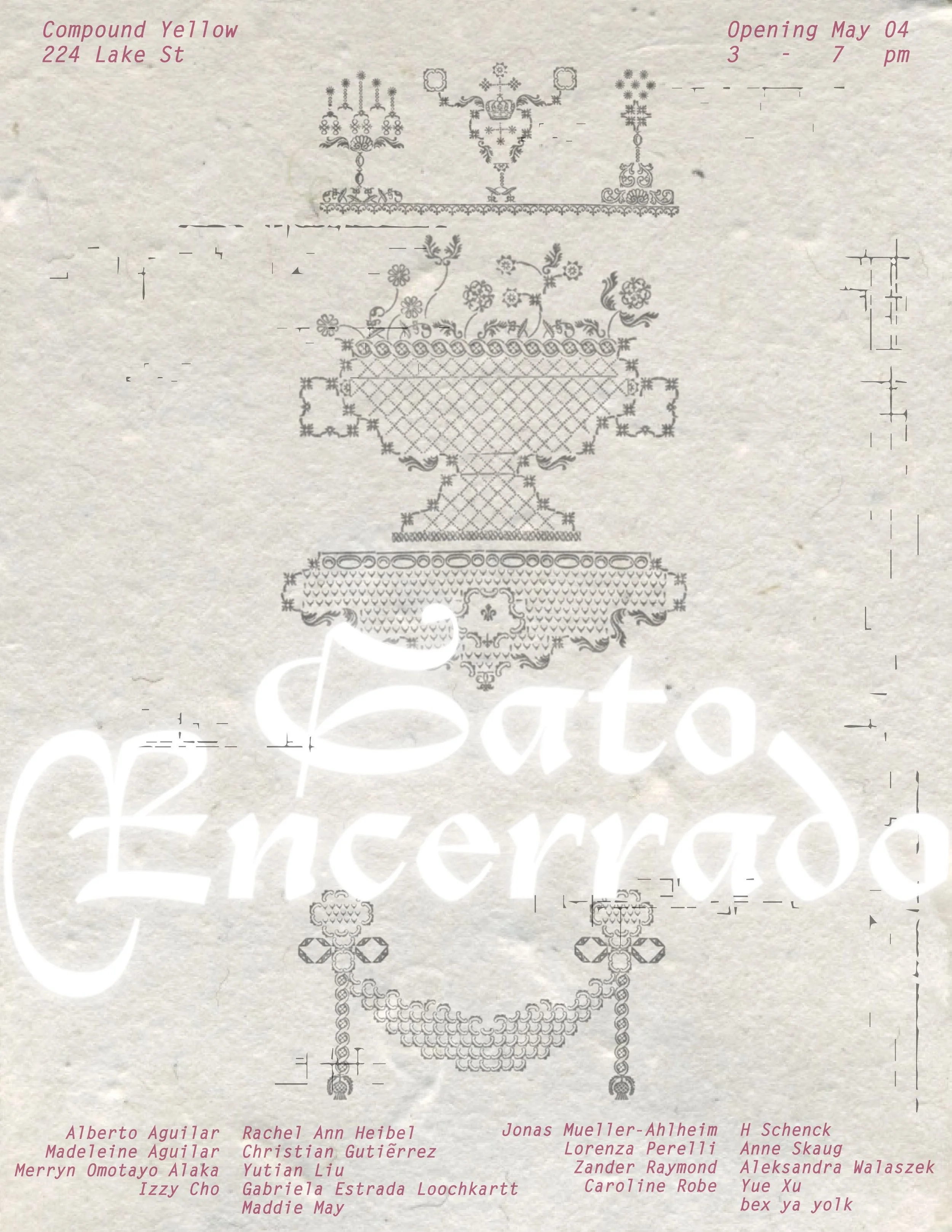
MAY 4
“Gato Encerrado: A Meditation on Uprootedness, a Preface to Goodbye” OPENING
Opening: May 4, 2024, 3:00 - 9:00pm
Open by apppointment
Please join us for the opening reception of
Gato Encerrado: A Meditation on Uprootedness, a Preface to Goodbye
Saturday May 4th
3pm to 9pm
*** Note the time change: we have extended the opening to 9pm to allow for more viewing time for light sensitive projects!
Featuring the work of:
Alberto Aguilar
Madeleine Aguilar
Jonas Mueller-Ahlheim
Merryn Omotayo Alaka
Izzy Cho
Christian Gutiérrez
Rachel Ann Heibel
Yutian Liu
Gabriela Estrada Loochkartt
Maddie May
Lorenza Perelli
Zander Raymond
Caroline Robe
H Schenck
Anne Skaug
Aleksandra Walaszek
bex ya yolk
Yue Xu
Gato Encerrado: A Meditation on Uprootedness, a Preface to Goodbye gathers the work of eighteen multigenerational Chicago-based artists whose practices aligned with those of the organizer as she was putting together an exhibition in response to a home in the midst of transition. The artists were given a written invitation, a tour of the space and a large amount of freedom to respond to the totality of Laura Shaeffer’s and Andrew Nord’s Oak Park home with their interventions.
The English idiom don't let the cat out (of the bag)— with its intention to avoid revealing hidden information or letting someone in on an in-joke— inspired the title of the show as much as the cat that resides in the home where the exhibition takes place. Later, the Spanish idiom Acá hay gato encerrado (there’s a trapped cat here) emerged. This expression alludes to a situation whose complex parts are not being fully revealed or understood. This pet, a “rescued” cat now living a stable and secure life, can’t wait to adventure outside and into the realm of uncertainty. Therefore, every time someone enters the space, a disembodied voice from inside the home will utter “don’t let the cat out!”, echoing the title of the show and hinting at something that is on the verge of being let loose through the artworks on site.
The nomadic impulse of this animal and his resistance to stability and routine are precisely the impulses that are given space in Gato Encerrado: as we create an illusion of safety and coziness around us, are we also secretly eyeing the door to escape the very shelter we have worked so hard to build?
By way of these kinds of questions, this exhibition pays homage to those who are at peace with the prospect of a permanently uncertain horizon: no dream house, no base, and maybe after some time: no place of origin. The artistic interventions inside the home disrupt the quotidian flows of movement and usage of objects while subtly pointing at one of the trapped cats, namely: how can one make a show about feeling uprooted inside such a beautiful house?
Poster design by bex ya yolk
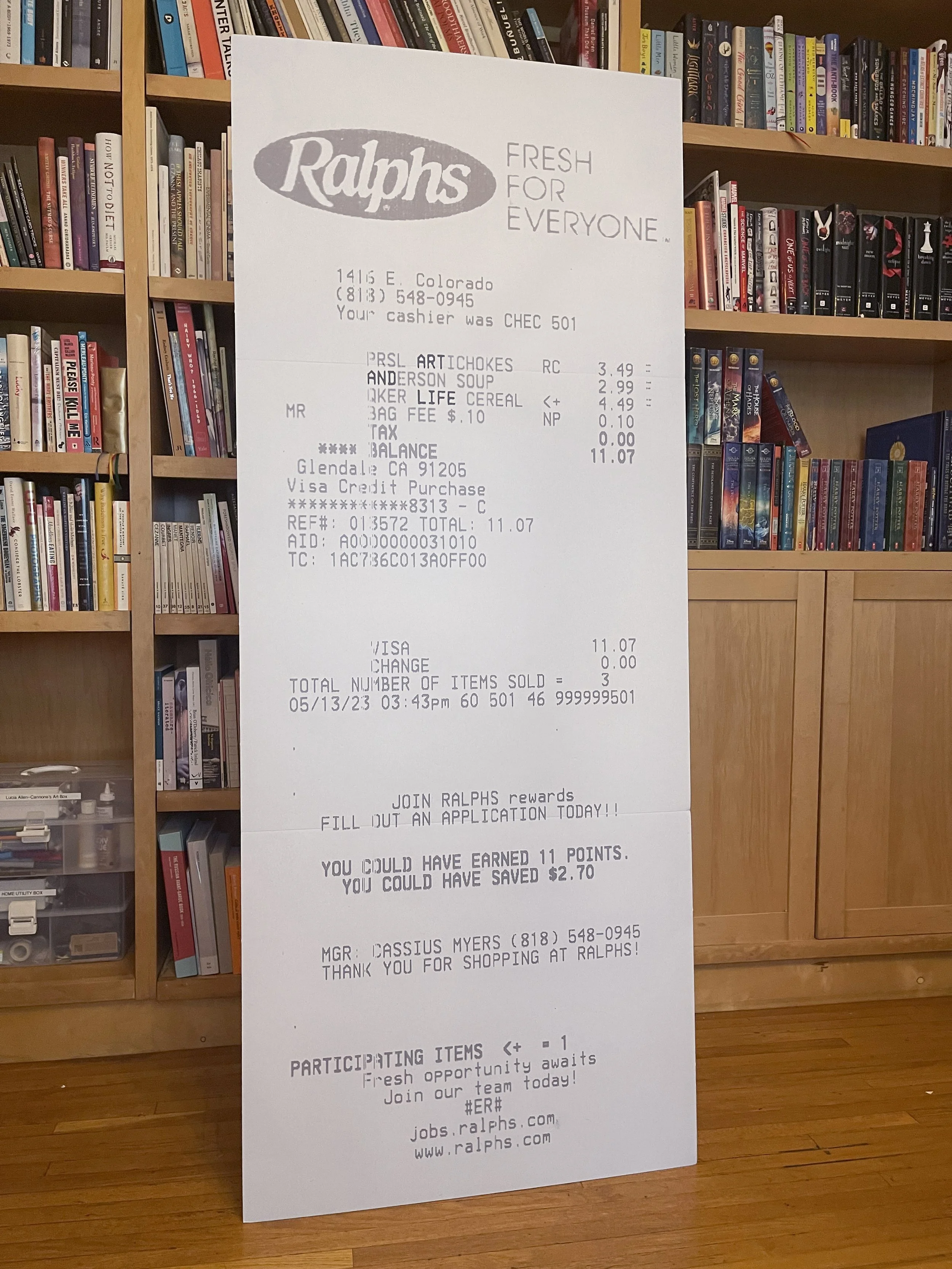
Image: Art and Life
Foam board print, 30 x 67”, 2024
MARCH 23 - MAY 4
“MANET/DEGAS” OPENING - GARY CANNONE
Opening: March 23, 2024, 3:00 - 6:00pm
Open Every Saturday from March 23rd, 2pm to 6pm
“Few artists are as well-equipped to meditate on the relationship between wheelchairs and doormats as Gary Cannone.” — overheard
Gary Cannone employs substitution, parody, props, and slapstick to create an art that embraces physical and conceptual deflection. Cannone, born in 1964, grew up in an immigrant household on Chicago’s northwest side in the 1970s and was fixated on comedy: Candid Camera, Norm Crosby, Mad Magazine, Tom & Jerry, Carol Burnett, and Andy Kauffman. The first fine art objects which interested him — such as Dada, Eva Hesse’s Hang Up, or Rauschenberg’s Erased De Kooning — had a structural playfulness similar to the comedy he loved.
Cannone’s early work included customer surveys, subliminal messaging, how-to books, libraries within libraries, conversion charts, and phone trees. In 2013, Cannone was diagnosed with a neurological illness which affects his cognitive function, manual dexterity, and ability to walk. His counterintuitive response has been to convert this into a boon to his art practice, crafting a methodology inspired by the phenomenological experience of his disability and converting his daily stumbling blocks into a generative force. His embroideries, doormats, furniture, and overhead objects focus our attention on obstacles in communication and movement, not as a source of frustration but as space for a kind of poetry.
Additional Links to Cannone’s work and reviews:
Artist: Gary Cannone
EXHIBITION DETAILS:
Title: “Manet/Degas”
Opening: March 23, 2024, 3:00 - 6:00pm
Closing: May 4; a closing reception is TBD
COMPOUND YELLOW
#244 Lake Street
Oak Park, Il, 60302
ABOUT COMPOUND YELLOW
Located just outside of Chicago in Oak Park, Illinois, Compound Yellow is an independent, multi-functional artist-run space and artist residency. We encourage experimental practices that nurture collective knowledge and cultivate critical discourse.
MEDIA INQUIRIES: Elizabeth Burke-Dain, eburkedain@gmail.com, 773.368.4928
For more information about this exhibition and Compound Yellow, phone Laura Shaeffer, Compound Yellow director, at 773.710.5464 or email info@compoundyellow.com
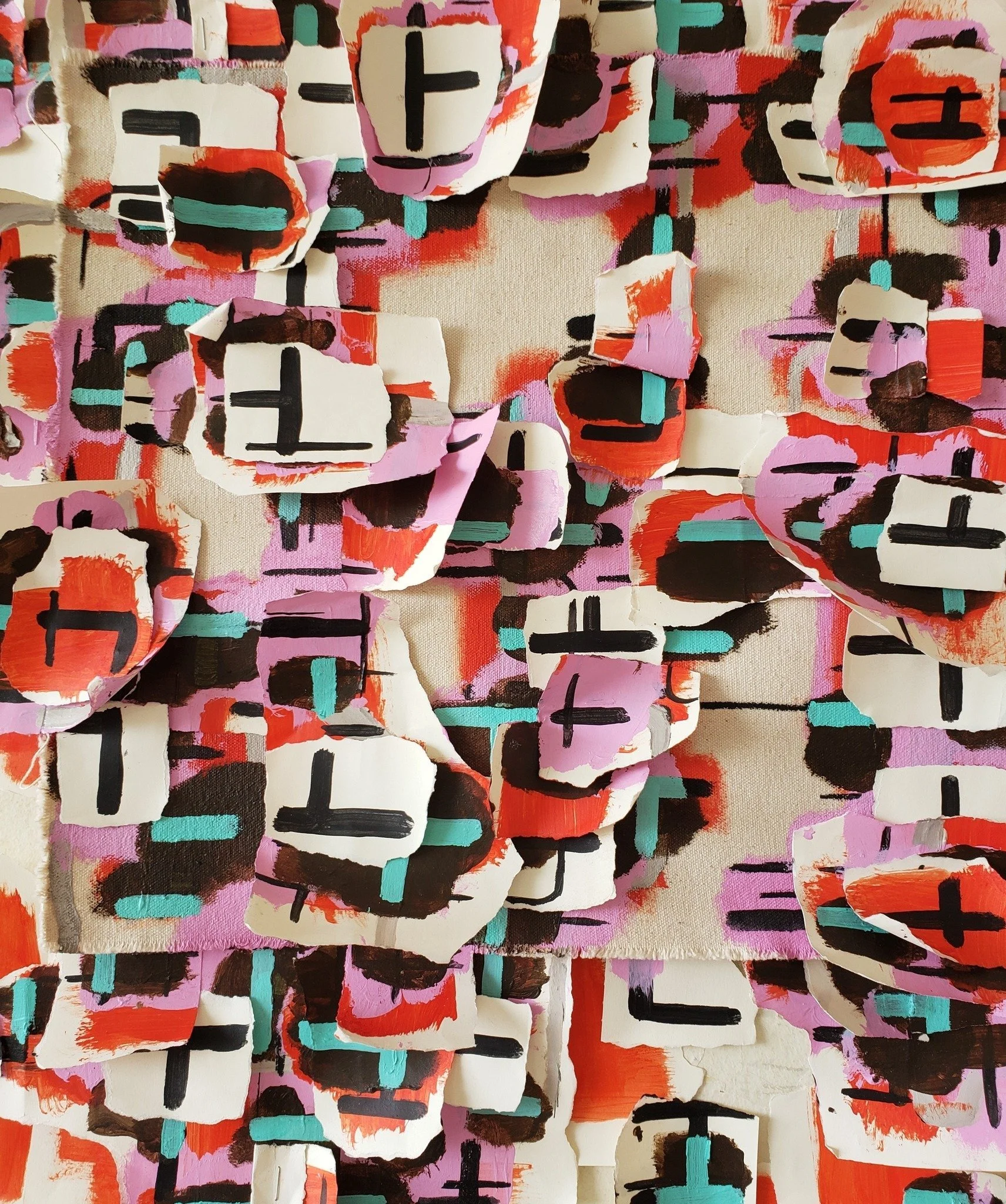
January 13 - February 24
All is Illusion, But Nothing Lies - New works by Luis Romero
Open Every Saturday from January 13th, 2pm to 6pm
Luis Romero constructs assemblages made primarily of paper, cardboard, and canvas. He uses the repetition of pattern and the layering of materials to create a visual space rich in ambiguity, where the relation of the mark to the surface is unsettled, and marks seem independent of the support. His works show the evidence of manual contact and are often made of perishable materials; but they look for a kind of incorporeality, a place where marks are both present and absent; existing and illusory. You can
think of them as organisms that contain an uncertain space. As if the teleporter in the original Star Trek series left travelers caught halfway in the process between dematerialization and rematerialization.
Luis Romero is a visual artist from Puerto Rico, living and working in Chicago since 1998. He completed his MFA in Painting and Drawing at the School of the Art Institute of Chicago and his BA in Philosophy, Literature, and Film at Boston University. Romero is a MacDowell Fellow and his work is in public and private collections in the US and Europe such as the Art Institute of Chicago, the Philadelphia Museum of Art, US Department of State, and the Fidelity Corporate Collection, among many others.
Website: https://romeroluis.com
IG: @total_romero