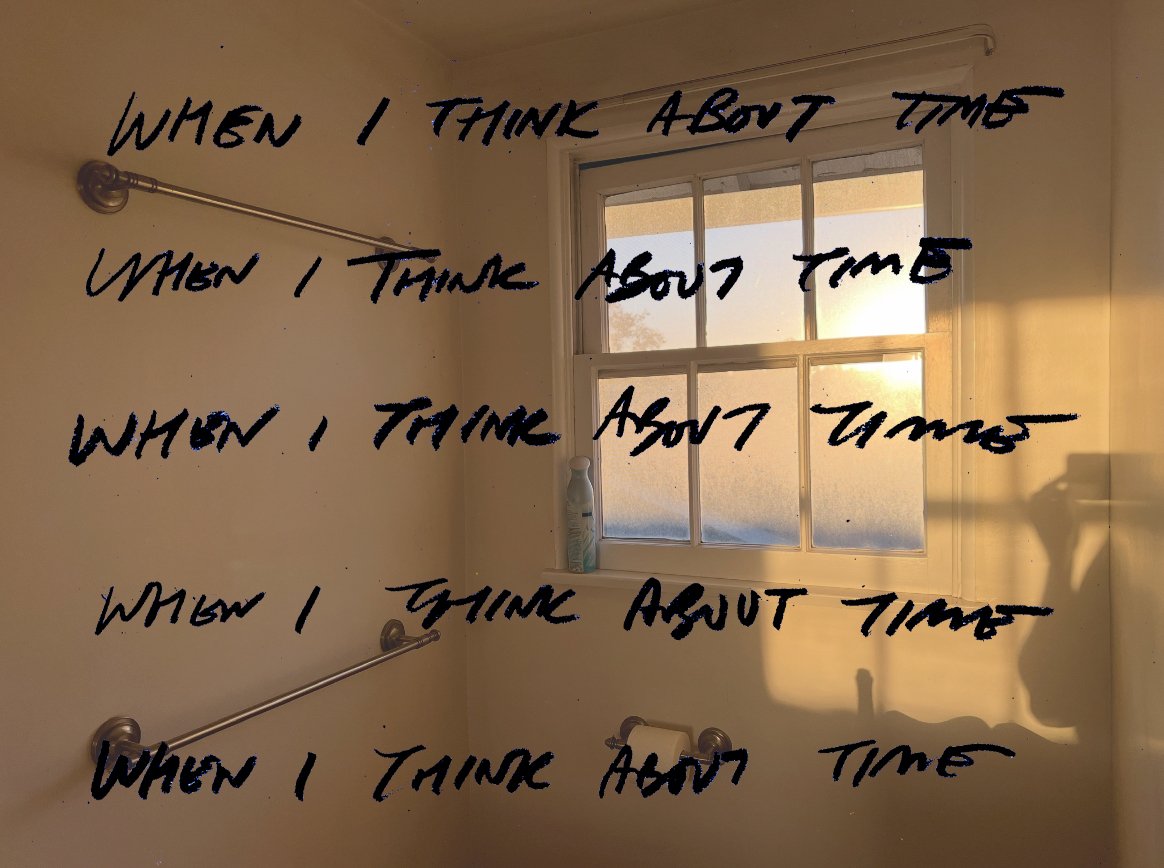
Opening Reception: H Marsh Schenck "when i think about time"
when i think about time is a site-specific installation examining how time is experienced, measured, distributed, and utilized within (U.S.) American culture. Rooted in my experience as a trans person living with Functional Neurological Disorder (FND), this exhibition challenges the idea of time as a universal construct and reveals access to time as inequitable.
My relationship to time fundamentally changed after learning how to navigate: chronic fatigue alongside forty-hour work weeks, prolonged waiting periods for specialists in between other, weekly medical appointments, and the general daily labor of eating, sleeping, and cleaning the house. Time became something to budget rather than live in. Something scheduled months in advance. Something shaped as much by economic circumstance, disability, and bureaucracy as by clocks or calendars. when i think about time asks: Who has access to time? How is time measured? Who determines its value? How much of our lives are lost to systems that demand productivity while delaying care? And what becomes possible when we begin to reclaim our time?
The objects in this exhibition reflect these ideas through materiality. Building on the installation from my past exhibition, Both/And: a queer archive of belonging (Boundary, Chicago, 2025), this new body of work similarly uses objects as reservoirs for history, while also pointing viewers to assess their understanding of time. Mirrors, clocks, mobility aids, annually pruned Christmas trees, and sculptures assembled from inherited, found, and repurposed materials become records of lived experience, examining how memory, disability, labor, tradition, and identity construct our understanding of time.
Within the exhibition, clocks reflected in mirrors suggest that time is always contextual: perspective determines interpretation as much as measurement. A collection of walking canes on an aromatic cedar rack nods to histories, adaptations, and care. An ascending series of pruned Christmas trees marks an annual tradition, transforming holiday waste into a visual record of grief, healing, renewal. Every object carries multiple histories, resisting singular definitions of purpose, authorship, permanence, and time itself.
Rather than presenting time as linear, when i think about time embraces cycles, transition, and continual reinvention. Memories become artifacts. Artifacts become collaborators in remembering. Traditions preserve histories while creating opportunities for change. Sculptures function as unburied time capsules, preserving histories, accumulating time, and changing with age.
Once we unpack and identify that the social normative construct of time is not a universal concept, we must ask ourselves: Who determines ‘normative’ standards of time, and who continues to maintain systems that influence how we access time? Whose interpretation and application of time is disciplined, medicalized, or exploited? Who has time off? Who has to wait for healthcare? Who has to sacrifice time simply to survive? Who benefits from these structures?
These questions extend beyond disability. They ask us to reconsider how time is allocated across systems of labor, healthcare, education, class, race, and identity. Ultimately, when i think about time invites viewers to reconsider not only their perception of time, but its function, authorship, and application. This exhibition imagines a collectively authored time, one founded in community and generosity rather than extracted through labor; defined by shared meals, holiday rituals, art exhibitions, conversation, collaboration, and trust.
when i think about time is an invitation to imagine: If we remove productivity as the primary qualitative measure of a human life, what new systems could we imagine? What could we accomplish if we internalized rest and care not as irresponsible distractions from productivity, but as essential tenets of meaningful lives?
How do we slow down time? And, most importantly, how do we create time for one another?
*********************************
H Marsh Schenck (b. 1988, he/him) is an artist/educator/curator who challenges (US) American essentialism with an interdisciplinary practice informed by acts of care. His work is rooted in his experience as a disabled trans person and influenced by a transient, rural upbringing. Schenck integrates themes of identity and place by utilizing found and discarded materials, exploring various art methodologies, and examining social concepts of value, meaning, and connection.
H Marsh Schenck earned his BFA in printmaking at Bradley University (2010) and his MFA in intermedia at University of Texas Arlington (2013). His work has been exhibited domestically and internationally at several institutions including, Design Museum (Chicago), BWA Wrocław Galleries (Poland), 2nd Berlin Becher Triennial (Germany), The Modern Art Museum (Fort Worth), Urban Glass (NY), Traver Gallery (Seattle), MAC (Dallas), Boundary (Chicago), Mayfield (Chicago), The Plan (Chicago), Compound Yellow (IL), and other locations throughout the United States. Schenck has received funding from the Dallas Museum of Art, the MAC Dallas, Penland School of Crafts, Pilchuck Glass School, Kotteman Foundation, and Southern Graphics Council International. He is the co-creator of the social project Mud Campaign, which provided free arts education and funding for LGBTQ+ youth in Texas. He has held memberships with BEEFHAUS (curator), 500X Gallery (VP), and Comfort Station (Gallery Manager). Currently, he teaches at the Art Institute of Chicago and recently held the titles of Instructional Specialist and Anti-racist Transformation Team Fellow at Columbia College Chicago.